Process is invisible in the ledger
A broker statement records fills, not rules. A winning trade that broke your plan and a losing trade that followed it look identical on a P&L line.

DCM Trading Journal · Early access
A review and analytics journal for discretionary traders who trade technical setups. It records the market context, the setup and the execution of each position, so you can see whether your process held, not just whether the month was green.
DATA · CONVICTION · EXECUTION · ADVANTAGE
The journaling problem
A profit figure is the end of a chain of decisions. It does not say whether the trade was taken in a market that supported it, whether the setup was actually complete, whether the entry and exit followed the plan, or whether it was the third attempt at the same move. Two traders can post the same monthly result with completely different processes, and only one of them is repeatable.
A broker statement records fills, not rules. A winning trade that broke your plan and a losing trade that followed it look identical on a P&L line.
Three entries, two stop-outs and one winner on the same directional idea are one opportunity. Counted as four trades, your win rate and expectancy describe something that never happened.
The same setup can perform differently when the higher timeframes agree, when the broader market regime is against it, or when breadth is thin. Without that context recorded at the time, you cannot tell skill from weather.
The product
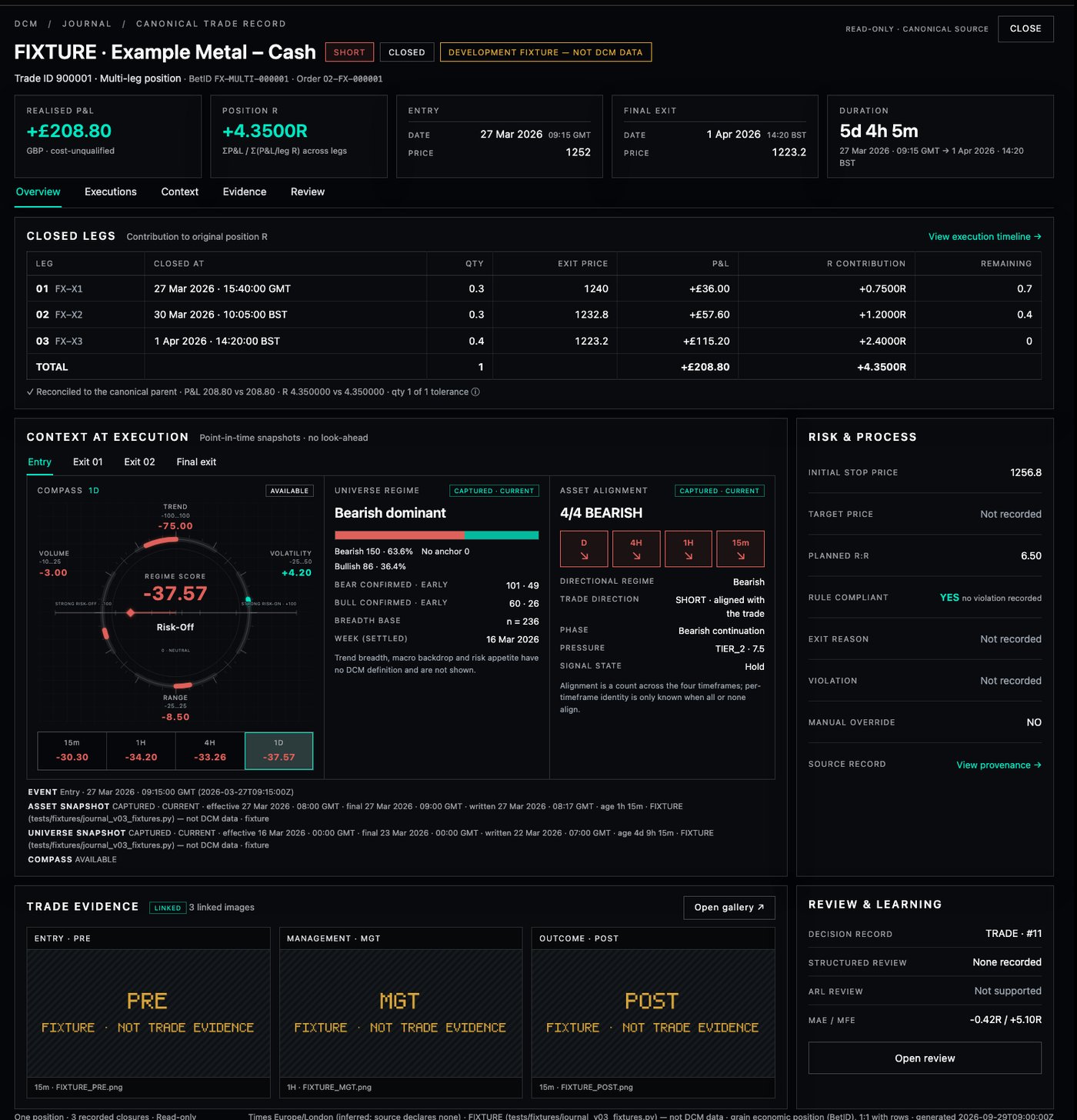
The screens below are from the current DCM build. They show development fixture data, not live account data, which is why each carries a fixture banner. Private account details never appear on this site.

The DCM approach
Each of these is recorded on its own, so that a review can say which one explains a result. Capabilities are marked honestly: what the current build does today, and what is being developed for early-access users.
Where a regime snapshot was captured before the event, the record shows the market regime, breadth and multi-timeframe alignment as they stood at entry and at each exit, never a later value. Where no snapshot qualifies, the panel says "unavailable" instead of guessing. Capture coverage is still being improved.
Pre-trade, management and post-trade screenshots are matched to the position by order reference and shown on the record, so the chart you acted on is one click from the outcome it produced.
Initial stop, target, planned reward-to-risk, rule-compliance, recorded violations and manual overrides sit beside the financial outcome rather than inside it. A profitable rule break stays visible as a rule break.
Scaling out across several closes is treated as one position with one initial risk, and the record lists the closing legs it holds with each one's share of that risk. Leg data is not yet complete for every position: DCM is still reconciling partial closes at source, and where legs are missing or unreadable the record says so rather than filling the gap.
Repeated attempts at the same directional move will be grouped into one opportunity so that expectancy and win rate describe ideas, not fills. This is being built and is not yet available.
A structured grade of how complete the setup was, held apart from both execution and outcome. Planned for early-access users; not in the current build.
Reviewing the setups you did not take, and whether leaving them alone was the right call, is part of the roadmap. It is not available today.
Who it is for
Early access
The Journal is in active development. Applying registers your interest and starts a conversation. It does not guarantee a place, and no access date or price has been set. We will not share your details with anyone else.
Thank you. We have your details and will reply by email to talk about your journaling needs.
FAQ
A web-based review and analytics tool that records each position together with the market context, setup, execution and evidence behind it, so that you can review your process rather than only your P&L.
It runs in a web browser on desktop, tablet and phone. There is no separate mobile app. Trades enter the Journal from broker trade history; the current build is built around CMC Markets exports, and other brokers are not yet supported.
Discretionary traders who use technical setups, size against a stop and want a systematic review of their decisions. It is not designed for fully automated or high-frequency trading.
The Journal is in development and is used internally at DCM. Early access means expressing interest, discussing your journaling needs with us, and then being considered for access as the product opens up. There is no published access date, price or guarantee of acceptance.
No. The Journal is a review and analytics tool for your own decisions. DCM does not provide trade signals, recommendations or investment advice, and nothing on this site should be read as such.
No tool can guarantee trading returns, and we do not claim that this one does. Trading carries the risk of loss. What the Journal offers is a clearer, evidence-based record of your process, which is yours to act on.
Your journal data is yours. Nothing from any trader's journal is published, and the screenshots on this page use development fixture data or synthetic numbers rather than live accounts.
Privacy notice